What is Managed File Transfer (MFT)?
A Secure, Compliant and Auditable Approach to Enterprise File Movement
Introduction
Managed File Transfer (MFT) is an enterprise-grade approach to securely moving files between systems, users, applications, and external partners.
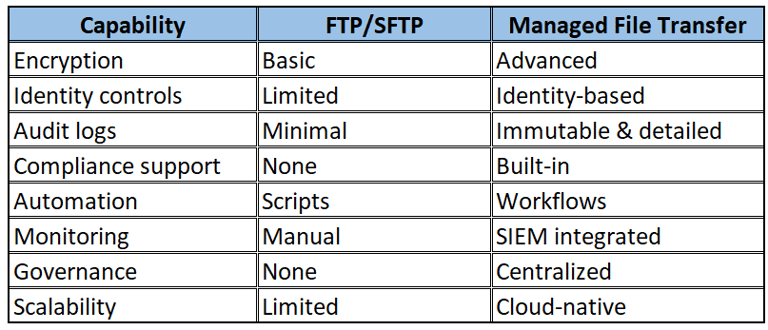
Unlike basic file transfer tools such as FTP or SFTP, Managed File Transfer platforms provide:
Centralized governance
Identity-based access control
Encryption
Audit trails
Compliance enforcement
Automation and workflows
Monitoring and alerting
In simple terms:
FTP/SFTP moves files. However, Managed File Transfer governs, secures, and controls file movement. For regulated and security-conscious enterprises, MFT has become the standard architecture for secure data exchange.
Why Traditional File Transfer Is No Longer Enough?
Historically, organizations relied on:
FTP servers
SFTP scripts
Email attachments
Shared folders
Ad-hoc portals
While these methods provide basic connectivity, they lack:
Identity verification
Centralized policies
Auditability
Compliance controls
Monitoring
Scalability
This creates significant risks:
Credential leaks
Data breaches
Ransomware exposure
Compliance failures
No forensic evidence
Manual operations
As regulations and cyber threats increased, enterprises needed something stronger. That’s where Managed File Transfer emerged.
What Does Managed File Transfer Do?
A modern MFT platform adds governance and security on top of basic file transfer.
Core Capabilities
🔒 Security
Encryption in transit and at rest
Identity-based access control
Role-based permissions
Zero Trust enforcement
📜 Auditability
Immutable logs
Full transfer history
Evidence for audits
Activity tracking by user and system
⚖ Compliance
Retention policies
WORM storage
Data residency controls
Regulatory alignment (HIPAA, SOC2, GDPR, etc.)
⚙ Automation
Workflow orchestration
Scheduled jobs
Partner onboarding
Policy-based routing
🚀 Performance & Scale
Large file support
Parallel transfers
Cloud-native scalability
Together, these features transform file transfer from a technical utility into a governed enterprise system.
How MFT Is Different from FTP or SFTP?
👉 For a deeper comparison, see:
→ MFT vs SFTP vs Secure File Sharing
When Do Enterprises Need Managed File Transfer?
Organizations typically adopt MFT when they:
Handle regulated or sensitive data
Exchange files with partners or vendors
Require audit trails
Need compliance (HIPAA, SOC2, FedRAMP, GDPR, DPDP)
Run large or automated workflows
Replace legacy SFTP servers
Support AI/analytics pipelines
If any of these apply, SFTP alone is usually insufficient.
Modern MFT Architecture
Modern Managed File Transfer platforms are:
Cloud-native
API-driven
Identity-first
Policy-based
Zero Trust aligned
Integrated with security operations
Leading enterprises deploy MFT directly inside their cloud environment to maintain full control of data.
For example, Zapper Edge runs entirely within your Azure tenant, combining:
Zero Trust security
Compliance-ready controls
High-performance transfers
Data residency enforcement
Secure partner exchange
👉 Explore the High-Speed, Zero-Trust, AI Ready MFT platform
Related Concepts
To go deeper, explore:
Security
Compliance
AI & Modern Data
Implementation
Frequently Asked Questions
What is Managed File Transfer in simple terms?
Managed File Transfer is a secure, governed system for sending and receiving files with encryption, audit logs, and compliance controls.
Is MFT more secure than SFTP?
Yes. SFTP encrypts data, but MFT adds identity controls, monitoring, auditability, and governance.
Who uses Managed File Transfer?
Healthcare, banking, government, pharma, and any enterprise handling sensitive or regulated data.
Can MFT replace SFTP?
Yes. Modern MFT platforms are backward compatible with SFTP while adding stronger controls.
Is Managed File Transfer required for compliance?
While not always explicitly required, most compliance frameworks expect the controls that MFT provides.
Next Steps
If you’re evaluating Managed File Transfer for your organization:
👉 See how Zapper Edge implements secure, cloud-native MFT → managed-file-transfer-platform
👉 Explore implementation services → zapper-edge-managed-file-transfer-services-on-azure