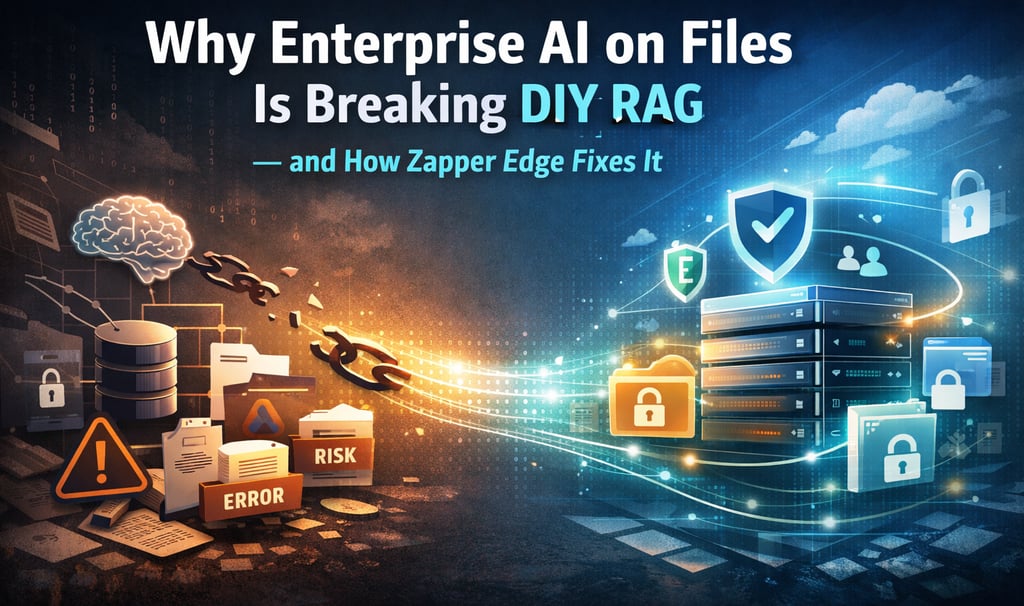
Why Enterprise AI on Files Is Breaking DIY RAG - and How Zapper Edge Fixes It
Generative AI on enterprise files introduces hidden security, compliance, and operational risks when built using DIY RAG stacks. This post explores why traditional LLM + vector database approaches fall short in regulated environments and how Zapper Edge delivers secure, zero-trust, file-native AI designed for auditors and production workloads.t description.
AI READY MFT
12/30/20253 min read
This article is part of Zapper Edge’s Zero Trust and AI-Ready Managed File Transfer knowledge series for regulated enterprises.
For the past two years, enterprises have been presented with a simplified narrative around generative AI adoption: connect a large language model such as OpenAI or Claude to a vector database, layer Retrieval-Augmented Generation on top, and enable natural-language querying over documents. While this approach is effective for prototypes and controlled demonstrations, it fails to hold up when applied to real enterprise file environments that involve regulatory constraints, security boundaries, and operational governance. As organizations move from experimentation to production, the gap between promise and reality becomes increasingly apparent.
The Reality of AI on Enterprise Files
Enterprise files are fundamentally different from generic documents used in AI demos. They are governed by regulations such as HIPAA, GDPR, and SOC 2, encrypted using PGP and customer-managed or customer-owned keys, and scoped across organizations, roles, projects, and contractual boundaries. File flows are event-driven, with arrivals, updates, and reprocessing triggering downstream actions, and every interaction must be auditable to capture who accessed what data, when, and for what purpose. Any AI system operating on these files must respect these constraints by design rather than treating them as afterthoughts.
The Hidden Cost of OpenAI or Claude with DIY RAG
Although RAG appears simple in theory — ingesting files, chunking content, generating embeddings, storing vectors, and querying them with an LLM — the operational reality is significantly more complex. Teams must manage conversation state across sessions, operate and scale vector databases, implement access-control filtering at query time, enforce encryption boundaries, and maintain strict tenant isolation. Observability, including prompt tracing and drift detection, must be custom-built, while scaling requires careful handling of rate limits, retries, and backpressure. On top of this, compliance teams demand proof that enterprise data was never leaked into model training or unauthorized contexts. Collectively, these responsibilities transform application teams into de facto AI platform operators.
Why Files and AI Require a Platform, Not Just APIs
These challenges arise because traditional GenAI APIs were designed for stateless prompts and flat documents, not for long-lived, regulated enterprise file systems. Platform-oriented AI systems fundamentally change this model by abstracting away infrastructure concerns. Session management, secure context injection, retrieval governance, observability, and policy enforcement are handled natively by the platform. This eliminates the need for hand-rolled orchestration logic and allows teams to focus on business outcomes rather than maintaining fragile integration layers.
Zapper Edge’s File-Native AI Control Plane
Zapper Edge is built on the principle that AI should be brought to the data, not the other way around. Enterprise files already managed within Zapper Edge reside in Azure Data Lake Storage Gen2 or Azure Blob Storage, are encrypted using PGP and customer-managed keys, scanned with Defender for Storage, audited through Microsoft Sentinel, and scoped according to organization and role. AI execution is triggered in place using managed identities, preserving encryption and access boundaries while avoiding shadow copies and data sprawl. Files and AI operate within a single, unified control plane.
From RAG to File-Native Intelligence
Traditional RAG systems focus on retrieving document fragments that best match a query. Zapper Edge extends this concept by enabling semantic understanding of files within their operational and business context. This includes summarizing encrypted inbound files after controlled decryption, comparing file deliveries across time, detecting anomalies in partner uploads, answering natural-language questions on regulated datasets, and triggering workflows based on semantic signals rather than static rules. These capabilities are delivered without exposing data outside enterprise trust boundaries.
Why Pure API-Based Architectures Fall Short
Even advanced GenAI APIs assume stateless usage, minimal compliance pressure, and single-tenant environments. Enterprise file intelligence, however, requires persistent context, organization-aware isolation, secure retrieval, lineage tracking, and policy-driven execution. Attempting to retrofit these capabilities onto DIY RAG architectures often results in brittle systems, prolonged security reviews, and AI features that are ultimately disabled in production due to risk concerns.
The Zapper Edge Difference
Zapper Edge is not RAG layered on top of storage; it is a file-native AI platform designed for zero-trust environments and audit-first operations. By embedding governance, security, and AI execution at the platform level, it removes the need for organizations to build and maintain their own AI infrastructure. Teams operate on a ready-made control plane instead of constructing one from scratch.
Conclusion
Organizations that find themselves manually managing vector stores, persisting conversation state, filtering documents at query time, or repeatedly justifying data safety to auditors are rebuilding infrastructure that should already exist. Zapper Edge brings files, AI, security, and governance together into a single, cohesive system, enabling enterprises to move beyond experimental RAG implementations and toward secure, scalable, and production-ready file intelligence.