Regulatory Alignment: How Zapper Edge Maps to Global Compliance Frameworks
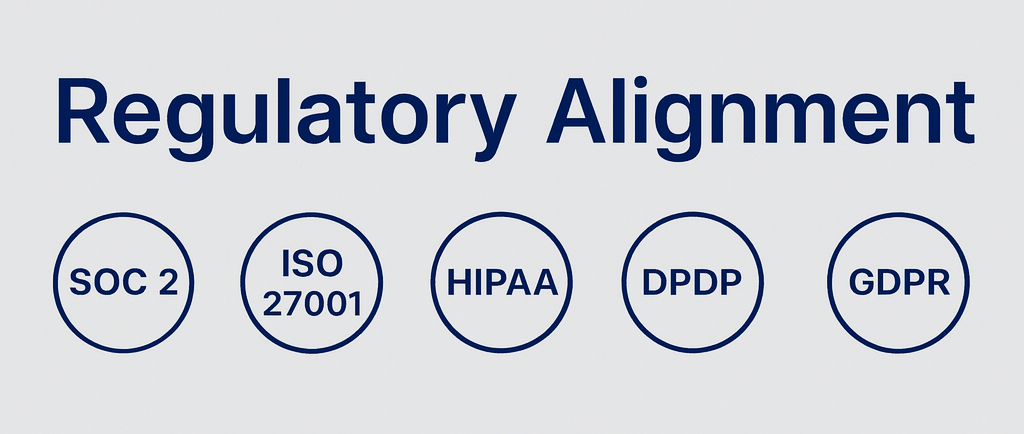
Zapper Edge turns compliance from a checklist exercise into a built-in capability. By enforcing Zero Trust principles at the architecture level—identity-first access, least privilege, encryption everywhere, and continuous auditability—it maps cleanly to SOC 2, ISO 27001, HIPAA, DPDP, and GDPR requirements. This eliminates the operational and audit risks inherent in legacy MFT systems.
COMPLIANCE
12/13/20253 min read
This article is part of Zapper Edge’s Zero Trust and AI-Ready Managed File Transfer knowledge series for regulated enterprises.
Modern compliance frameworks increasingly converge on the same core requirements: strong identity assurance, least privilege, encryption, auditability, data residency, and continuous monitoring. Legacy MFT platforms typically address these through documentation and compensating controls. Zapper Edge enforces them by architecture.
Below is a practical mapping of Zapper Edge capabilities to major global regulations and standards.
SOC 2 (Type II): Security, Availability, Confidentiality
SOC 2 evaluations focus on whether controls are not only designed correctly but operate continuously over time. Zapper Edge directly supports SOC 2 trust service criteria by eliminating shared credentials and enforcing identity-driven access for all users and systems. RBAC, MFA, and managed identities ensure that access to file transfers is authenticated, authorized, and continuously verified.
Encryption of data in transit and at rest using AES-256 and customer-managed keys satisfies confidentiality requirements, while immutable audit logs provide verifiable evidence of control operation during audit periods. Integration with SIEM platforms enables real-time detection and response, strengthening monitoring and incident management expectations under SOC 2.
Critically, Zapper Edge’s zero-ops architecture improves availability by removing dependency on customer-managed transfer servers, reducing outage and misconfiguration risks commonly flagged in SOC audits of legacy MFT platforms.
ISO/IEC 27001: Information Security Management Systems (ISMS)
ISO 27001 emphasizes systematic risk management, control enforcement, and demonstrable governance across information assets.
Zapper Edge aligns directly with Annex A controls related to access control, cryptography, logging, and secure system architecture. Identity-based authorization replaces network-level trust, reducing systemic risk. Encryption keys are managed through customer-controlled Key Vaults, aligning with cryptographic key management requirements.
Comprehensive logging and auditability support ISO controls for monitoring, event logging, and incident investigation. Because policies are implemented as code and version-controlled, organizations gain traceability and repeatability—key attributes expected in mature ISMS environments.
Unlike legacy MFT systems that rely heavily on procedural controls, Zapper Edge enforces security through technical design, reducing audit findings tied to human error or inconsistent enforcement.
HIPAA: Protecting Electronic Protected Health Information (ePHI)
HIPAA requires strict safeguards to ensure the confidentiality, integrity, and availability of ePHI—particularly when data is shared with external entities.
Zapper Edge supports HIPAA technical safeguards by encrypting ePHI both in transit and at rest, including PGP encryption for external transfers. Access is restricted using least-privilege RBAC and MFA, ensuring that only authorized users and systems can transmit or retrieve sensitive healthcare data.
Detailed audit trails record every access and transfer event, enabling covered entities to meet HIPAA’s audit control and monitoring requirements. Malware scanning and threat detection help protect data integrity by preventing malicious or corrupted payloads from entering downstream systems.
Because data remains within customer-owned Azure regions, Zapper Edge also supports HIPAA data residency and vendor risk management requirements often scrutinized during audits.
DPDP Act (India): Purpose Limitation, Security Safeguards, Accountability
India’s Digital Personal Data Protection (DPDP) Act places strong emphasis on purpose limitation, data minimization, security safeguards, and accountability.
Zapper Edge enables purpose-bound data movement through fine-grained, policy-driven access controls. Files can only be transferred by authorized identities for explicitly defined use cases, reducing the risk of over-collection or unauthorized secondary use.
Encryption, strong authentication, and continuous monitoring meet DPDP security safeguard expectations, while immutable logs provide accountability and traceability for regulatory inquiries. Because Zapper Edge allows customers to control deployment regions and storage locations, it supports DPDP-aligned data localization and residency requirements without architectural compromises.
Legacy MFT systems, by contrast, often struggle to demonstrate enforceable purpose limitation due to shared accounts and broad directory access.
GDPR: Data Protection by Design and by Default
GDPR mandates that organizations implement technical and organizational measures to protect personal data throughout its lifecycle, including during transfer.
Zapper Edge embodies data protection by design by ensuring that no file transfer occurs without explicit identity verification, authorization, and policy evaluation. Encryption using customer-managed keys supports GDPR’s confidentiality and integrity requirements, while granular access control and least privilege reduce unnecessary exposure of personal data.
Audit logs and SIEM integration enable timely breach detection and support GDPR’s accountability and incident reporting obligations. Data residency controls help organizations comply with cross-border transfer restrictions and localization requirements under GDPR.
Because Zapper Edge avoids shared infrastructure and keeps data within customer-owned environments, it significantly reduces third-party data processing risks—a common challenge under GDPR assessments of legacy MFT tools.
Compliance Enforced by Architecture, Not Assumption
Across SOC 2, ISO 27001, HIPAA, DPDP, and GDPR, the recurring theme is clear: regulators increasingly expect continuous, verifiable enforcement of security controls, not static configurations or policy documents.
Zapper Edge meets this expectation by embedding compliance into its architecture:
Identity replaces network trust
Encryption is mandatory, not optional
Policies are code, not checklists
Auditability is continuous, not retrospective
This architectural approach allows organizations to modernize file transfer without inheriting the systemic compliance risks of legacy MFT platforms—making Zapper Edge a durable foundation for regulated enterprises operating in an increasingly Zero Trust–driven world.